How to Play Sorry!: Setup, Rules, Scoring, Strategy, and Variations
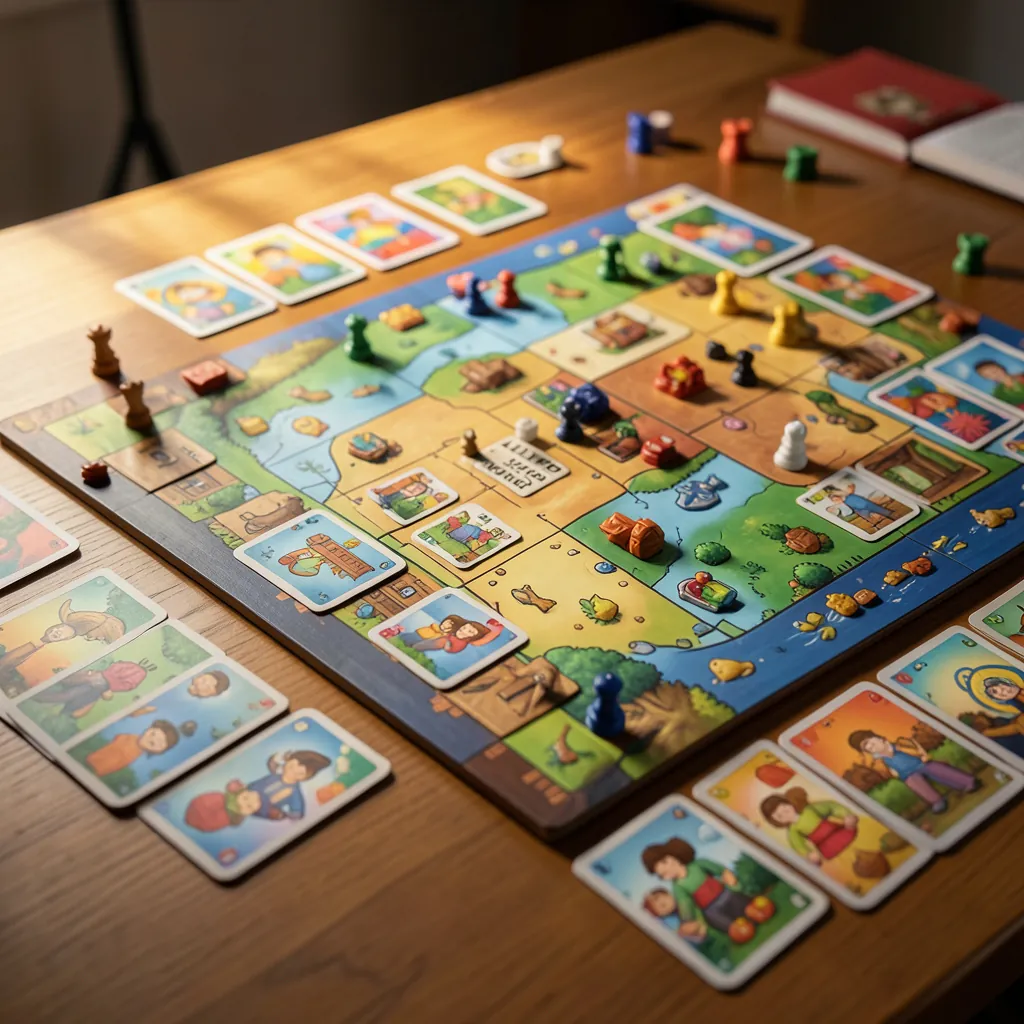
How to Play Sorry!: Setup, Rules, Scoring, Strategy, and Variations
Contents
🎲 Sorry! is a Hasbro/Parker Brothers board game for 2–4 players in which you draw cards to move pawns from Start to Home. The goal is to be the first player to get all of your pawns into your Home space by exact count. Cards control movement, and special cards let you bump opponents back to Start, slide, split a 7, or swap places.
Players: 2–4 (the classic rulebooks say 2, 3, or 4; the digital app is also 2–4)
Play Time: Not stated in the cited rules; setup time is 1–5 minutes in one source, and play varies by edition and player count
Age: Not stated in the cited rulebooks; the simplified classroom version is aimed at Grades K–3, while standard play requires reading card text
Difficulty: Easy to learn; standard card exceptions add complexity
Type: Board game with card-driven movement
Setup
- Choose colors and place pawns. Each player takes one color and places its pawns in the matching START area. Standard Sorry! uses 4 pawns per player; the digital Sorry World app uses 3.
- Prepare the deck. Shuffle the standard 44-card pack and place it face down in the center of the board. The standard pack has four each of 1, 2, 3, 4, 5, 7, 8, 10, 11, 12, and four Sorry cards; there are no 6 or 9 cards.
- Decide who goes first. The classic 1939/1958 rules say each player draws a card, highest card leads, Sorry counts highest, and the leader chooses color and plays first. Some classroom and app versions instead say players decide who goes first.
- Set up a discard area. Place played cards face up in the center discard area. If the draw pile runs out, reshuffle the discard pile and place it face down as the new draw pile.
- Point Sorry variant setup. In Point Sorry, deal five cards to each player, place the remaining cards face down as the draw pack, and start one pawn out for each player.
How to Play
- Draw one card on your turn. Place it face up in the center, then move one of your pawns according to the card. No player draws until the previous play is complete.
- Get pawns out of START first. In classic rules, a pawn leaves START only with a 1, 2, or Sorry card. When a 1 or 2 is used to start a pawn, place it on the starting circle; do not also move it forward that turn.
- Count every square. You may pass over your own pawns or opponents’ pawns, but every square must be counted, occupied or not.
- Never put two pawns on one square. If the only possible move would land on your own pawn, you forfeit the move under classic rules.
- Bump opponents on the track. If a pawn ends its move on a margin square occupied by an opponent’s pawn, the opponent’s pawn returns to its START.
- Use slides carefully. In the classic rules, if your pawn ends on a slide triangle of another color, it must slide to the circle at the end and remove every pawn on that slide, including your own. A pawn does not slide when it lands on a triangle of its own color.
- Enter the Safety Zone correctly. The 5 colored squares before Home are the Safety Zone. It is entered only by a pawn of the same color, from or through the square marked “Enters to Go Home.” Opponents normally cannot bump pawns there.
- Move Home by exact count. A pawn must reach Home with the exact number shown on the card. Once a pawn is in Home, it is out of play and is not moved again.
- Handle backward moves. A 4 moves a pawn backward 4 spaces. A 10 moves forward 10 or backward 1. If a pawn in the Safety Zone is forced backward by a 4 or 10, it may move back through the entrance square.
- Use a 7 as a full move or split it. A 7 may be split between two pawns as long as the full 7 squares are moved. It may be used to move pawns Home, bump opponents, or slide, but it cannot start a pawn or move a pawn backward.
- Use an 11 to move or swap. An 11 moves a pawn forward 11 spaces or swaps places with an opponent’s margin pawn. If neither move is possible or wanted, the move is forfeited. Safety Zone and START swap restrictions vary by edition.
- Use Sorry cards according to your edition. Classic rules use Sorry to bring a pawn out of START and bump an opponent; some modern summaries also allow moving 4 spaces forward; the digital app says it replaces an opponent’s pawn with one of yours. In Partnership Sorry, a Sorry card must be used even if it removes your partner’s pawn.
- Forfeit only when no legal move exists. If you cannot move the full number or make an allowed alternate move, your turn ends.
- Win by getting all pawns Home. The first player to move all of their pawns from START to Home wins. In the faster 3-pawn game, get all 3 Home.
What does each card do?
| Card | Standard/classic effect | Notes and conflicts |
|---|---|---|
| 1 | Start a pawn out or move one pawn forward 1 | Simplified classroom version removes the START restriction |
| 2 | Start a pawn out or move forward 2; classic text refers to an extra draw after the 2 | Some summaries omit the extra-draw detail |
| 3 | Move forward 3 | — |
| 4 | Move backward 4 | If only a Safety Zone pawn can move and you draw a 4, it must move backward 4 |
| 5 | Move forward 5 | — |
| 7 | Move 7 total, or split between two pawns; may move a pawn Home if another completes the full 7 | Cannot start a pawn or move backward |
| 8 | Move forward 8 | — |
| 10 | Move forward 10 or backward 1 | Backward move may be used from the Safety Zone |
| 11 | Move forward 11 or swap with an opponent’s margin pawn | START/Safety/Home swap restrictions vary by source |
| 12 | Move forward 12 | — |
| Sorry | Classic: bring a pawn out of START to bump an opponent; some summaries add move 4 forward; app: replace an opponent’s pawn with yours | Most edition-sensitive card; use your card text |
Which rules differ between sources?
| Issue | What one source says | What another source says | Safe way to play |
|---|---|---|---|
| Player count | Classic Hasbro/Winning Moves: 2, 3, or 4 players | Simple Wikipedia and app: 2–4 players | Use 2–4; no cited Sorry source supports 3–5 |
| First player | Classic: draw highest card; Sorry is highest | Classroom/app versions: players decide | Agree before play or follow your edition |
| Slide color | Hasbro/Winning Moves and classroom rules: slide only on another color, not your own | Simple Wikipedia’s wording appears reversed | Use the Hasbro/Winning Moves rule: another color slides; own color does not |
| Same-square stacking | Standard: no two pawns on one square | Simplified classroom version allows same-color pawns to stay together | Use standard rule unless playing the simplified classroom variant |
| Sorry card | Classic: bring a pawn out and bump an opponent | Some summaries add “or move 4 forward”; app says replace opponent’s pawn | Follow the card text in your copy |
| 11 swap restrictions | Classic says swap with a margin pawn | Modern summaries often forbid swapping START/Safety/Home pawns | Use modern track-only swap unless your edition says otherwise |
| 2 extra draw | Classic text refers to an extra draw after the 2 | Some summaries omit it | Check your edition’s card text |
Scoring
Standard Sorry! has no point scoring: the winner is simply the first player to move all of their pawns from START to Home according to the rules. In the faster 3-pawn game, the first player to get all 3 pawns Home wins. In Partnership Sorry, the first set of partners to get all 8 pawns into their proper Homes wins; if both partners get all 8 Home before either opponent gets 4 Home, the game becomes a “double game” worth two single wins. In Point Sorry, players score one point for every pawn they have Home, but the cited source excerpt cuts off before the full winner-bonus rule, so use your edition’s scoring card or rulebook for the final total.
💡 Strategy Tips
- Count exact Home moves early. Pawns need the exact number to enter Home, so keep at least one pawn positioned for a 1, 2, or other useful card.
- Do not waste the 7. Splitting a 7 can bump two opponents, trigger two slides, or finish one pawn while another completes the full 7.
- Use the Safety Zone as shelter, but watch backward cards. A 4 or 10 can force a Safety Zone pawn backward, and 11-swap rules vary by edition.
- Respect slides. In classic rules, sliding can be powerful, but every pawn on the slide is removed, including your own.
- Common beginner mistakes: forgetting that a 1 or 2 used to start a pawn does not also move it forward, forgetting exact-count Home, and forgetting that landing on your own color’s slide triangle does not trigger a slide.
🎲 Variations
- Faster game: Use 3 pawns per player instead of 4. The digital app also uses 3 pawns.
- Partnership Sorry: Played with 4 players; Red and Yellow are partners, Green and Blue are partners. You may use your drawn card for yourself or your partner, and the first team to get all 8 pawns Home wins.
- Point Sorry: Each player is dealt 5 cards, starts one pawn out, plays a card from hand, refills, and scores points for pawns Home. The source excerpt is incomplete on final scoring.
- Simplified classroom version: Use 40 number cards 1–10, remove the Sorry card, remove the rule that only 1 or 2 can leave START, and allow same-color pawns to share a space. This is designed for non-readers and young children.
- Digital Sorry World: A 2–4 player app version with 3 pawns, a modified deck, exact-count Home, and a Sorry card that replaces an opponent’s pawn with one of yours.
- 2-player play: The standard rules support 2 players, with each player controlling one color. The cited sources do not give special 2-player Sorry rules; Partnership Sorry needs 4 players.
❓ FAQ
How many players can play Sorry!?
Sorry! is for 2–4 players in the cited rules. The classic rulebook lists 2, 3, or 4 players; Simple Wikipedia and the app also give 2–4. No cited Sorry source supports 3–5 players.
How do you win Sorry!?
You win by being the first player to move all of your pawns from START to Home by exact count. Standard play uses 4 pawns; the faster game and the app use 3. Partnership Sorry is won by the first team to get all 8 pawns Home.
Can you play Sorry! with 2 players?
Yes. The standard rules support 2, 3, or 4 players, so 2 players can each control one color. The cited sources do not provide a separate 2-player variant; Partnership Sorry requires 4 players.
Is Sorry! hard to learn?
No. The basic draw-and-move idea is easy, but the standard cards add exceptions such as backward moves, split 7s, slides, and swaps. The simplified classroom version with number cards 1–10 is designed for younger or non-reading players.
How long does a game take?
The cited rules do not give a fixed play time. One source lists setup time as 1–5 minutes, and actual play varies by player count, edition, and whether you use the faster 3-pawn game.
What do you need to play Sorry!?
You need a Sorry! board, 16 markers in four colors (4 each of red, yellow, green, and blue), and a standard 44-card Sorry deck. The simplified classroom version uses a 40-card number deck 1–10 instead.
Related guides
- Backgammon Direction of Play: Complete How-to-Play Guide
- How to Play Backgammon: Complete Rules, Setup & Strategy Guide
- backgammon how to
- How to Play Backgammon: Complete Rules, Setup, Scoring, and Strategy