How to Play Go: Rules, Strategy, and Winning Tips
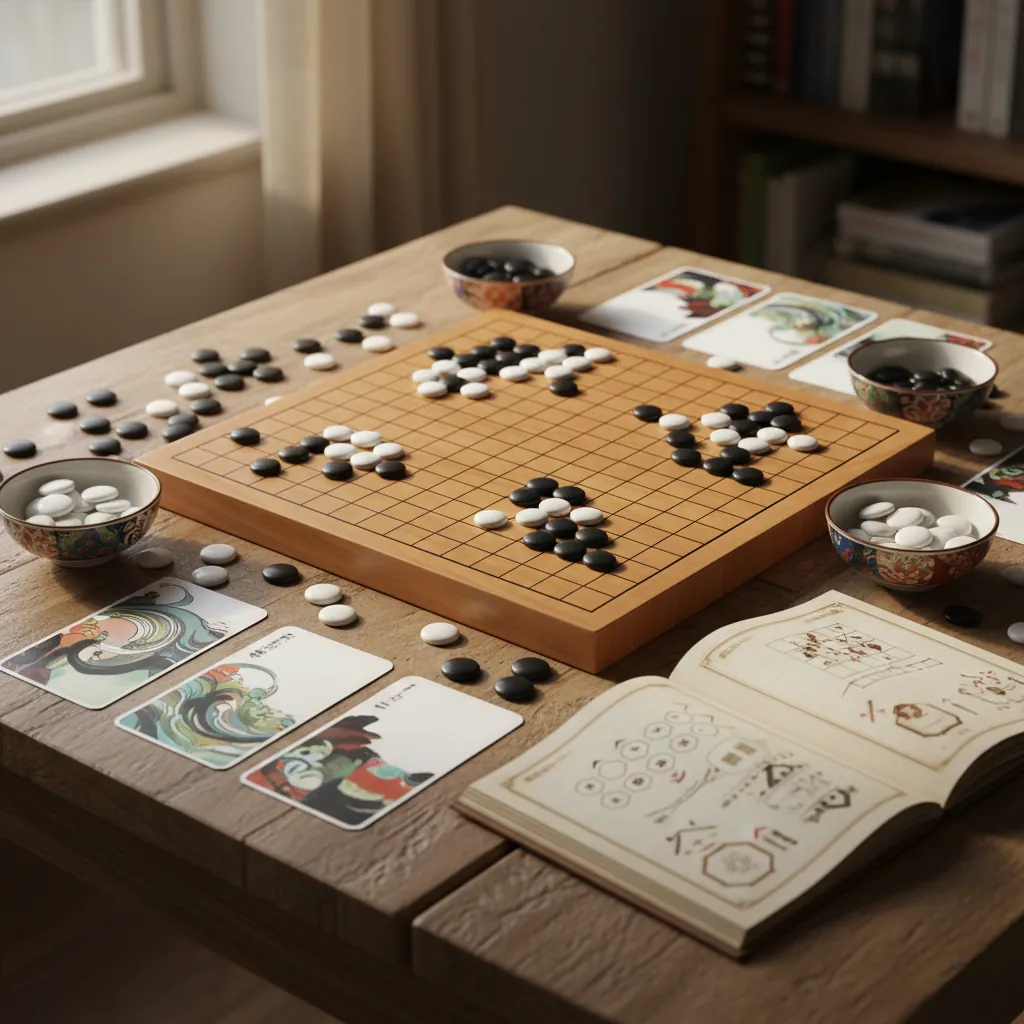
How to Play Go: Rules, Strategy, and Winning Tips
Contents
Go is an ancient two-player strategy board game where opponents compete to control territory by placing black or white stones on a grid. Originating in China over 2,500 years ago, it’s played on a 19×19 board (or smaller variants for beginners) and blends simple rules with deep strategic complexity. Players aged 6+ can learn quickly, but mastery demands years of practice.
What You Need
- Go board: 19×19 grid (smaller 9×9 or 13×13 boards for beginners)
- Stones: 181 black and 180 white
- Two players (Black moves first)
How to Play
- Opening: Black places the first stone on any board intersection. Players alternate turns.
- Placing stones: Each stone must occupy an empty intersection and cannot be moved afterward.
- Capturing: Remove opponent stones by surrounding them on all orthogonally adjacent points (no diagonals).
- Liberties: Groups must have at least one open adjacent point (“liberty”) to survive. Example: A single stone has 4 liberties.
- Ko rule: A player cannot immediately recapture a stone if it recreates the previous board position.
- Ending: Consecutive passes end the game. Dead stones (unable to avoid capture) are removed.
How to Win
- Territory scoring (Japanese/Korean): Count empty points enclosed by your stones, plus captured stones.
- Area scoring (Chinese): Count stones on the board plus enclosed points.
- Komi: White receives compensation points (typically 6.5) for moving second. Highest total wins.
Strategy Tips
- Balance influence and territory: Control the center early but secure edges efficiently.
- Create “eyes”: Two separate empty spaces within a group make it uncaptureable.
- Ko fights: Weigh immediate gains against long-term positional advantage.
- Handicaps: Stronger players give weaker opponents extra starting stones (e.g., 2-9 stones on marked points).
FAQ
Q: How long does a game typically last?
A: Casual games: 20–90 minutes; professional matches: 1–6+ hours.
Q: Can Go be played on smaller boards?
A: Yes! Beginners often use 9×9 or 13×13 grids to learn.
Q: What’s the difference between territory and area scoring?
A: Territory scoring counts enclosed spaces + captures; area counts stones + spaces. Results rarely differ by more than 1 point.
Conflict note: Sources disagree on exact komi values (some cite 5.5, others 6.5 or 7.5). Tournament standards vary by region.
Related guides
- Backgammon Direction of Play: Complete How-to-Play Guide
- How to Play Backgammon: Complete Rules, Setup & Strategy Guide
- backgammon how to
- How to Play Backgammon: Complete Rules, Setup, Scoring, and Strategy
- How to Play Basic Checkers (Draughts): Rules, Setup, Strategy and Variations