how to play chess game for beginners
Contents
- How do you set up a chessboard?
- How do chess pieces move?
- How does scoring and winning work?
- 💡 Strategy tips for beginners
- 🎲 Common variations
- ❓ FAQ
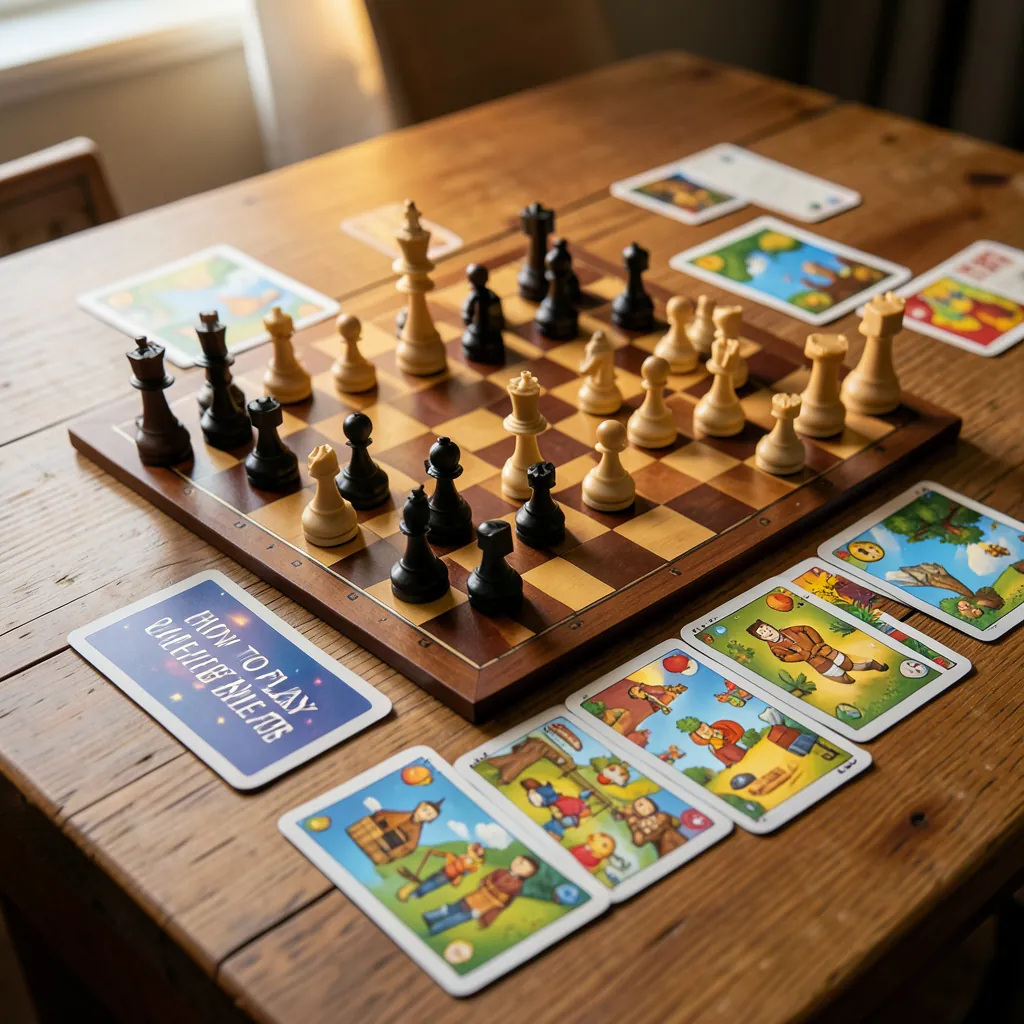
♟ Chess is a two-player strategy game played on an 8x8 checkered board where the goal is to checkmate your opponent’s king by placing it under an inescapable threat of capture.
Players: 2
Play Time: 10-60 minutes
Age: 6+
Difficulty: Medium
Type: Abstract strategy game
How do you set up a chessboard?
- Place the board with a white square at each player’s right-hand corner.
- Arrange the rooks in the corners, followed by knights next to them, then bishops adjacent.
- Place the queen on her color (white queen on white square, black on black); the king occupies the remaining central square.
- Line up 8 pawns in front of the other pieces.
How do chess pieces move?
Numbered steps for each piece’s movement:
- Pawn: Moves forward 1 square (2 on first move); captures diagonally. Promotes to any piece (except king) upon reaching the last rank.
- Rook: Moves any number of squares horizontally/vertically.
- Knight: Moves in an “L” shape (2 squares in one direction + 1 square perpendicular). Jumps over other pieces.
- Bishop: Moves diagonally any distance.
- Queen: Combines rook + bishop (any direction).
- King: Moves 1 square in any direction. Cannot move into check.
Special moves:
- Castling: King moves 2 squares toward a rook; rook jumps to the king’s far side (conditions: neither has moved, no squares between are attacked).
- En passant: Pawn captures an opponent’s pawn that just moved 2 squares forward as if it moved 1.
How does scoring and winning work?
- Checkmate: Win by trapping the opponent’s king with no legal moves to escape attack.
- Draw: Stalemate (no legal moves but king not in check), threefold repetition, or insufficient material (e.g., king vs. king).
💡 Strategy tips for beginners
- Control the center (e.g., squares e4, d4, e5, d5) early.
- Develop knights and bishops before queens and rooks.
- Avoid moving the same piece repeatedly in the opening.
- Protect your king (usually by castling).
- Watch for “forks” (attacking two pieces at once with a knight/pawn) and “pins” (immobilizing a piece to protect a more valuable one).
🎲 Common variations
- Handicap games: Remove a piece (e.g., queen or rook) for unbalanced play.
- Speed chess: Timed games (e.g., 5 minutes per player).
- Chess960: Randomized starting positions for pieces on the back rank.
| Piece | Movement | Capture | Special Rules |
|---|---|---|---|
| Pawn | Forward 1 (2 first) | Diagonal 1 | Promotion, en passant |
| Knight | L-shape | Jumps to target | Only piece that jumps |
| Bishop | Diagonally unlimited | Same as move | Confined to one color |
| Rook | Straight unlimited | Same as move | Castling |
| Queen | Any direction unlimited | Same as move | Most powerful |
| King | 1 square any direction | Same as move | Cannot move into check |
❓ FAQ
Q: Can you play chess with 2 players?
A: Yes, chess is strictly a 2-player game.
Q: How do you win chess?
A: Checkmate the opponent’s king or win by resignation.
Q: Is chess hard to learn?
A: Basic rules are easy (30 minutes), but mastery takes years.
Q: What do you need to play?
A: A chessboard, 32 pieces (16 per player), and an opponent.
Q: How long does a game take?
A: Casual games: 10-60 minutes; tournament games: hours.
Q: Can pawns move backward?
A: No, pawns only move forward.
Related guides
- Backgammon Direction of Play: Complete How-to-Play Guide
- How to Play Backgammon: Complete Rules, Setup & Strategy Guide
- backgammon how to
- How to Play Backgammon: Complete Rules, Setup, Scoring, and Strategy
- How to Play Basic Checkers (Draughts): Rules, Setup, Strategy and Variations