How to Play Battleship: Setup, Rules, Scoring, and Good Strategies
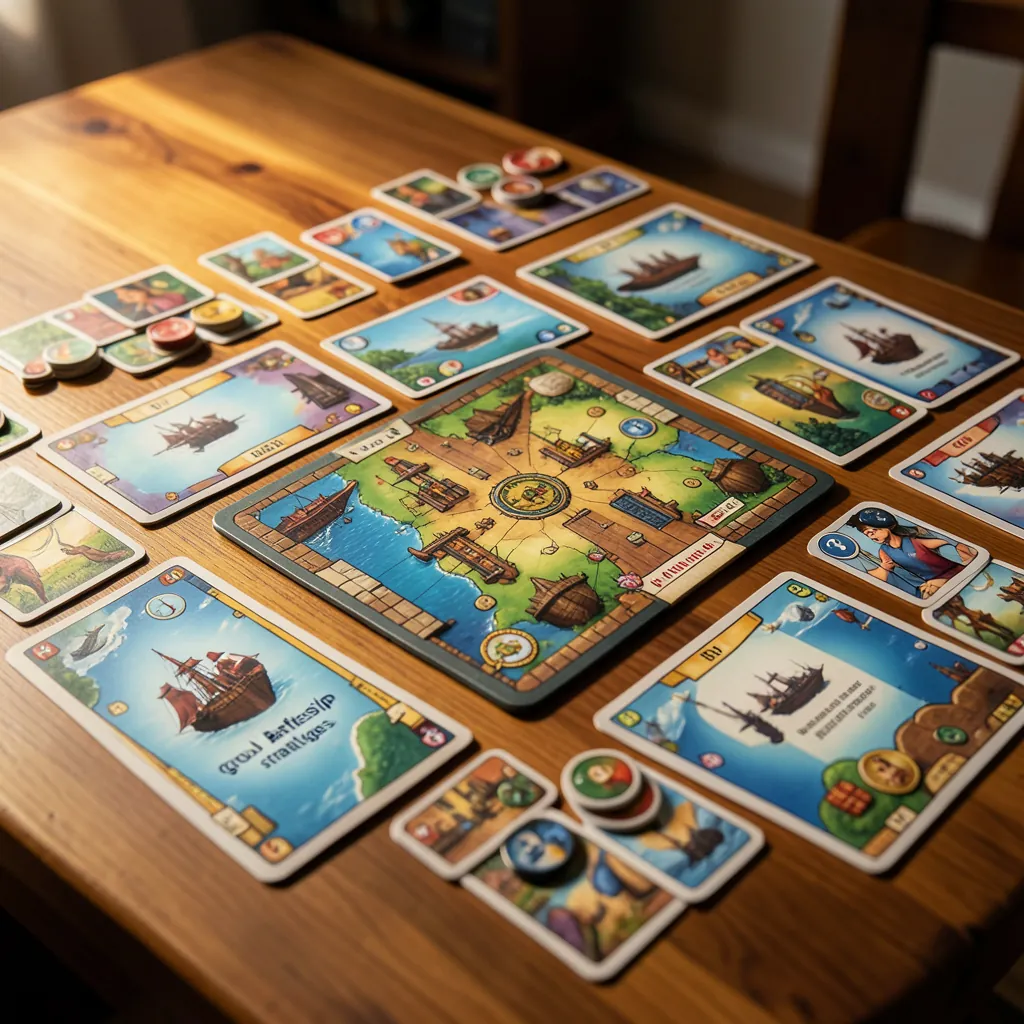
How to Play Battleship: Setup, Rules, Scoring, and Good Strategies
Contents
🎲 Battleship is a two-player hidden-information board game: each player places five ships of varying sizes on a 10×10 grid and tries to sink the opponent’s fleet before losing their own. The goal is to use shot results and miss patterns to sink all five enemy ships.
Players: 2
Play Time: Not specified in the sources; depends on turns
Age: Not specified in the sources; Source 2 describes it as commonly associated with children’s board games
Difficulty: Easy to learn; strategy improves odds (Source 2)
Type: 2-player hidden-information board game
Source note: Sources 1, 3, and 4 describe the video game World of Warships, not the tabletop game Battleship. This guide uses Source 2 and Source 5 for setup, rules, scoring, and strategy; where the sources are silent, such as exact play time and age rating, the guide says so rather than inventing details.
Setup
- Each player takes a 10×10 grid board that is hidden from the other player (Source 2).
- Place five ships of varying sizes on your own board (Source 2). Source 2 does not list exact ship names or lengths; Source 5 mentions a “sub” or single-square small ship as an example of the smallest ship.
- Keep your ship positions hidden from your opponent; the game depends on each player not seeing the other’s unrevealed board (Source 2).
- Optionally agree on a placement style as a house rule: random, pattern, edges, spaced, or grouped (Source 5).
- If you use Source 5’s placement advice, hide small ships especially carefully: the smaller the ship, the harder it is to find, so place small ships well hidden and try not to place them close to other ships.
How to Play
- Players take turns. On each turn, fire one salvo at one cell on the opponent’s hidden 10×10 grid (Source 2).
- Name the cell or coordinate you are targeting.
- The opponent announces whether the shot is a miss, a hit, or a hit that sinks a ship (Source 2).
- Mark the result on your tracking board. Both hits and misses provide information: hits help infer where ships are, and misses help infer where ships are not (Source 2).
- When every cell of a ship has been hit, that ship is sunk; mark it as sunk (Source 2).
- Continue alternating turns until one player has sunk all five of the opponent’s ships. That player wins; the other player loses (Source 2).
Scoring
The Battleship sources used here describe no point scoring. Winning is binary: sink all five of your opponent’s ships before they sink all five of yours (Source 2). If you play repeated games, you can track wins and losses, but Source 5 discusses repeat-opponent strategy rather than a point system.
💡 Strategy Tips
- Use feedback instead of pure guessing. A miss tells you where a ship is not; a hit gives you a starting point for inference (Source 2).
- Hunt locally after a hit. Source 2 describes a “Random+” strategy that prefers cells next to known hits, and a “Random++” strategy that follows consecutive hits until a miss. Source 5 warns that adjacent and diagonal follow-up shots are common, so vary this against repeat opponents.
- Prioritize high-probability cells and avoid known-miss areas. Source 2’s Tier strategies avoid cells next to misses and prefer cells next to hits. Source 5’s “intersecting channels” idea looks for open channels long enough to hide the largest remaining ship.
- Spread your opening shots. Source 5 suggests random opening choices or a quadrant-and-edges opening salvo, then switching to intersecting-channel searches once misses build up. Do not repeat the same opening salvo against repeat opponents; Source 5 says it will be anticipated.
- Place ships unpredictably and hide small ships. Source 5 says random placement is harder to detect where there is no regular pattern, while predictable patterns can be anticipated. It also says smaller ships are harder to find, so hide them well.
Strategy comparison table
| Strategy or option | Source basis | How to use it | Caveat |
|---|---|---|---|
| Random opening shots | Source 2; Source 5 | Fire at random cells or use a quadrant/edge opening salvo to cover the board | Source 5 warns that repeated opening salvos can be anticipated |
| Follow adjacent squares after a hit | Source 2; Source 5 | After a hit, search neighboring cells; Source 2’s Random++ follows consecutive hits until a miss | Source 5 notes many players use adjacent/diagonal follow-ups, so repeat opponents may expect it |
| Prefer cells next to hits and avoid cells next to misses | Source 2 | Use the hit/miss board state to prioritize likely ship cells | These are heuristic strategies; they improve odds but do not guarantee hits |
| Intersecting channels | Source 5 | Once misses form, look for intersecting channels long enough to hide the largest remaining ship | Works best for longer ships and is not applicable to the smallest sub/single-square ship |
| Random ship placement | Source 5 | Place ships without a regular detectable pattern | Source 5 says random placement can be harder to detect, but it is not invulnerable |
| Spaced or grouped placement | Source 5 | Spaced placement avoids follow-up hits; grouped placement can exploit players who avoid squares near sunk ships | These are placement strategies, not official rules; choose deliberately |
| Probability-based search | Source 2 | Source 2 notes the “Linear Theory of Battleship” favors evaluating the board for highest-probability cells instead of fixed patterns | Source 2 did not implement every strategy, so exact results depend on opponent and placement |
🎲 Variations
- Standard 2-player game: Battleship is commonly a 2-player game in Source 2. Use the standard hidden 10×10 boards and five ships of varying sizes per player.
- 3+ player or solo play: The provided Battleship sources do not describe supported 3+ player or solo rules. Do not assume one from these sources.
- Placement house rules: Source 5 lists random, pattern, edges, spaced, and grouped ship-placement approaches. These change how easy your fleet is to detect.
- Repeat-game house rule: Source 5 suggests changing your placement strategy while using the same attack strategy against a repeat opponent who may mimic your prior patterns.
- Small-ship note: Source 5 refers to a sub or single-square small ship. Source 2 only says each player has five ships of varying sizes, so use exact fleet composition only if your copy of the game specifies it.
❓ FAQ
How many players can play Battleship?
Battleship is commonly a two-player game in Source 2. The provided Battleship sources do not describe a supported 3+ player version.
How do you win at Battleship?
Sink all five of your opponent’s ships before they sink all five of yours (Source 2). The sources describe a win/loss game, not a point-scoring game.
Is Battleship hard to learn?
No. Source 2 describes it as a commonly known 2-player guessing game with simple turn-by-turn miss/hit/sink feedback; strategy can greatly improve your odds, but the basic rules are easy to learn.
How long does a game of Battleship take?
The Battleship sources do not give a fixed clock time. Source 2 reports simulated matchups with average turn counts ranging from 42.8 to 95.7 in the results shown, but that is turns, not minutes.
What do you need to play Battleship?
You need two hidden 10×10 grids, five ships of varying sizes per player, and a way to mark hits and misses (Source 2). Source 5 also refers to a sub or single-square small ship in its placement tips.
Are the World of Warships sources relevant?
Not for tabletop Battleship rules. Sources 1, 3, and 4 are about the video game World of Warships; this guide uses Source 2 and Source 5 for the board game Battleship.
Related guides
- Best Battleship Strategy: How to Play and Win
- How to Play Backgammon: Rules, Setup, and Strategy
- how do you play backgammon board
- how do you play battleship