How to Set Up and Play Checkers (Draughts): Rules, Board Setup, Scoring, and Strategy
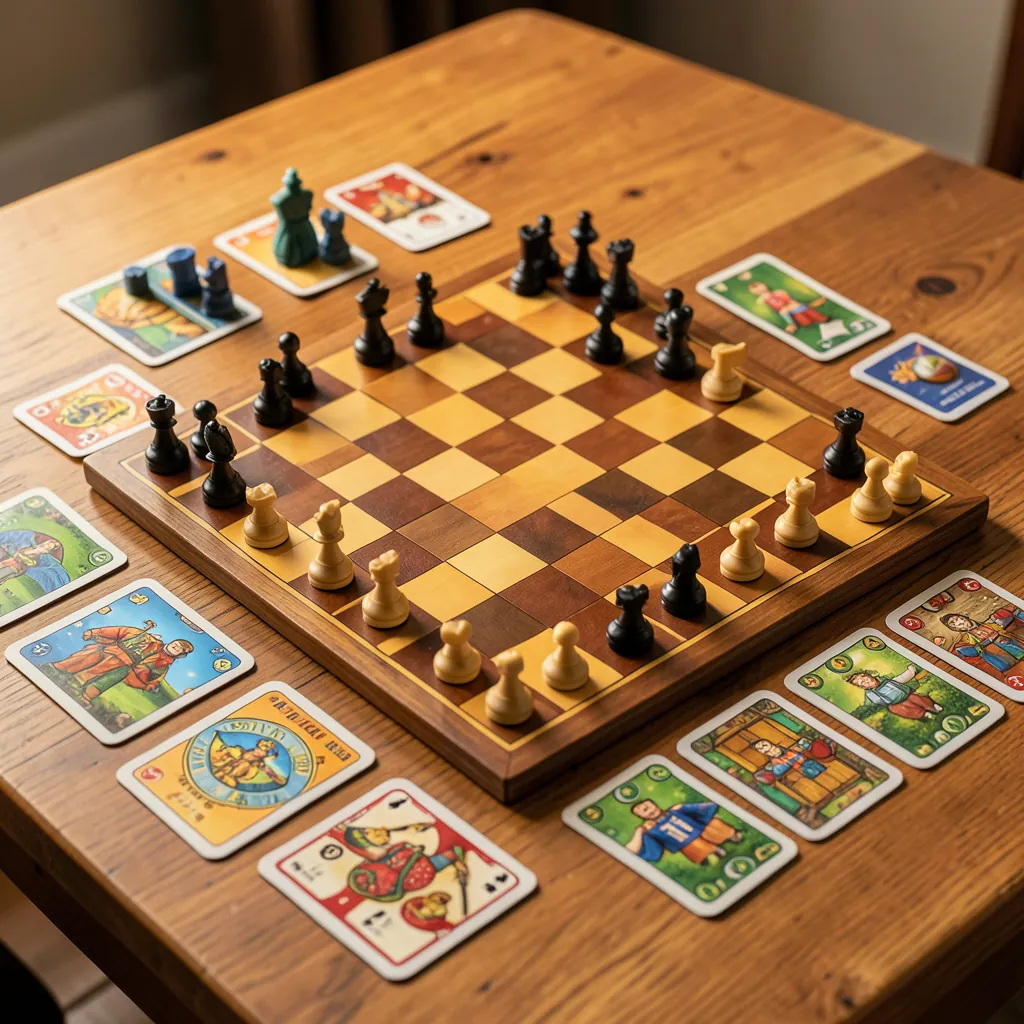
How to Set Up and Play Checkers (Draughts): Rules, Board Setup, Scoring, and Strategy
Contents
♟️ To set up checkers (draughts), use an 8×8 board, place 12 pieces per player on the dark squares of the three rows nearest each player, and leave the middle two rows empty. Checkers is a two-player abstract strategy game; the goal is to capture all opponent pieces or leave the opponent with no legal move.
Players: 2
Play Time: Not fixed in the sources; Source 4 has 1860 delay rules only
Age: 5+ (Jaques London set)
Difficulty: Easy
Type: Abstract strategy board game
Setup
- Use a standard 8×8 checkerboard. It has 64 alternating light and dark squares; standard English checkers/draughts uses only the 32 dark squares (Sources 1–4). Source 5 contains a conflicting note that light or dark squares are acceptable if both players agree—see the conflict flag below.
- Orient the board consistently. Each player should have a dark square at the near-left corner and a light square at the near-right corner. Sources phrase this differently but agree: Source 1 says dark near-left; Sources 2–3 say an empty light square in each player’s right corner; Source 4 says the bottom-left corner square is black; Source 5 says a light square on the corner to each player’s right.
- Assign colors. Use two sets of 12 pieces, traditionally black/dark versus white or red. Sources 1, 4, and 5 say Black/dark usually moves first; Sources 2–3 say the player who goes first takes the dark-colored pieces. Source 5 also allows players to agree on colors.
- Place 12 pieces per player. Put each player’s 12 pieces on the dark squares of the three rows nearest that player: four pieces per row, filling every dark square in those three rows.
- Leave the middle empty. The two center rows should have no pieces at the start, so 24 pieces are on the board and the middle of the board is open.
- Choose the first player. Common methods in the sources are previous winner goes first, coin toss, or agreement (Sources 2–3, 5). Traditional match rules give Black the first move (Sources 1, 2–3, 4).
Source key: S1 = Jaques London; S2/S3 = USA TODAY graphics; S4 = Spayth 1860; S5 = wikiHow.
| Setup item | What the sources support | Conflict / note |
|---|---|---|
| Board and squares | S1–S4: 8×8 board, play on dark/black squares. S1: 32 dark squares in play. | S5 says light or dark squares are acceptable if both players agree. This conflicts with S1–S4. Use dark squares for standard English checkers/draughts. |
| Pieces | S1–S5: 12 per player, 24 total. | None. |
| Starting rows | S1–S5: three nearest rows per player, four pieces per row, middle two rows empty. | None. |
| Board orientation | S1: dark near-left. S2–S3: light square in right corner. S4: bottom-left black. S5: light square on right corner. | Wording differs; the described positions are consistent. |
| First move/color | S1, S4, S5: Black/dark usually first. S2–S3: first player takes dark pieces. S5: players may choose colors by agreement. | Variation in how first player/color is chosen, not a rules conflict. |
| King marking | S1: stack a captured piece of the same color. S2–S3, S5: stack a captured checker or flip it. | None. |
How to Play
- Take turns moving one piece. Players alternate; move one checker per turn. Source 1 notes there is no dice and no chance element in draughts.
- Move an ordinary piece one square diagonally forward. A “man” moves one diagonal step forward into an empty dark square. Ordinary pieces cannot move backward, sideways, or straight (Sources 1–3, 5).
- Capture by jumping. If your piece is diagonally adjacent to an opponent’s piece and the dark square immediately beyond is empty, jump over the opponent’s piece and remove it from the board (Sources 1–5).
- Captures are compulsory in English draughts/checkers. Sources 1 and 5 explicitly say that if a jump is available, you must take it; if several captures are available, you may choose which one. Sources 2–3 describe jumping but do not spell out the compulsory rule in their summaries.
- Continue chain jumps. If the same piece can jump again after landing, it must keep jumping until no further jump is available, according to Sources 1 and 5. Sources 2–3 describe these as “double jumps” but do not clearly state whether a second jump is optional.
- Crown kings on the far row. When a man reaches the far edge/king row, it becomes a king. Mark it by stacking a captured piece on top or flipping it over (Sources 1, 2–3, 5). Source 1 adds that a piece ends its move on the king row even if it arrived by a jump and cannot continue capturing that same turn.
- Kings move and capture both ways. A king may move one diagonal square forward or backward during a non-capture move, and it can capture diagonally forward or backward (Sources 1 and 5). Ordinary men remain forward-only.
- Win by capture or blockade. A player wins by capturing all opponent pieces, or by leaving the opponent with no legal move (Sources 1, 2–3, 5).
Scoring
Checkers/draughts does not use point scoring in the sources. The game ends when one player has captured all opponent pieces or the opponent has no legal move; that player wins. Source 5 calls the blockade win “less common”; Sources 1 and 2–3 also recognize it. No partial points are described. In match play, Source 4’s 1860 laws say players cast lots for color once at the start of a match and then alternate colors; the first move belongs to Black.
💡 Strategy Tips
- Control the center. Pieces in the middle cover more diagonals and force captures; edge pieces are safe but passive (Sources 1, 2–3, 5).
- Guard your back row. Keeping pieces on your king row blocks opponent kings; give it up only for a clearly bigger gain (Sources 1, 2–3, 5).
- Move in pairs and avoid solo raids. A lone checker pushed into enemy territory is easy to jump; keep backup behind advancing pieces (Sources 2–3, 5).
- Use compulsory capture as a tactic. Offer one piece to force a reply that lets you capture two, or trade when ahead to simplify; avoid trades that help the opponent crown a king (Sources 1, 2–3, 5).
- Don’t only defend the edges. A beginner mistake is hiding on the side rail; work toward captures and central control instead (Sources 1 and 5).
🎲 Variations
- Checkers vs. draughts: same game; “draughts” is British and “checkers” is American (Sources 1–3).
- Player count: all sources describe standard two-player checkers/draughts. The sources do not provide an official 3–5 player version. For two players, use the standard 12-piece setup above.
- First-player/color house rules: choose first player by prior winner, coin toss, or agreement; players may agree on colors, though traditional rules give Black/dark the first move (Sources 1–5).
- Match play: Source 4’s 1860 laws cast lots for color once at the start of a match, then alternate colors and keep Black moving first.
- King marking: stack a captured checker or flip the piece (Sources 1–3, 5).
- Rule conflict to verify: Source 5 says light or dark squares are acceptable if both players agree, and it also states that only a king can capture a king. Sources 1–4 specify dark/black squares, and they do not state the king-only-captures-king restriction. Treat both as house-rule/variation notes unless your set’s instructions say otherwise.
- Online play: Sources 2–3 note free checkers websites if you do not have a board.
❓ FAQ
How many players can play checkers?
Two. The sources describe checkers/draughts as a two-person game; they do not give an official 3–5 player version.
How do you win at checkers?
Capture all your opponent’s pieces or leave them with no legal move. Source 5 calls the blockade win less common, but Sources 1 and 2–3 also recognize it.
Can you play checkers with 2 players?
Yes—two players is the standard game. Each player takes 12 pieces and sets them on the dark squares of the three nearest rows, with the middle two rows empty.
Is checkers hard to learn?
No. The basic movement is one diagonal step forward, and Source 1 notes it is simple enough for a five-year-old to grasp; Jaques London lists its folding set as Ages 5+.
How long does a checkers game take?
The provided sources do not give a fixed average play time. Source 4’s 1860 laws mention delay calls: after five minutes, play must be completed within another minute; when only one capture is possible, time is called after one minute and another minute is allowed. Those are slow-play rules, not an average game length.
What do you need to play checkers?
A standard 8×8 checkerboard and 12 pieces per player, 24 total. A captured piece is useful for stacking a king, or you can flip the checker over (Sources 1–3, 5).
Related guides
- Backgammon Direction of Play: Complete How-to-Play Guide
- How to Play Backgammon: Complete Rules, Setup & Strategy Guide
- backgammon how to
- How to Play Backgammon: Complete Rules, Setup, Scoring, and Strategy