How to Set Up and Play Checkers on a Standard or Hexagonal Board
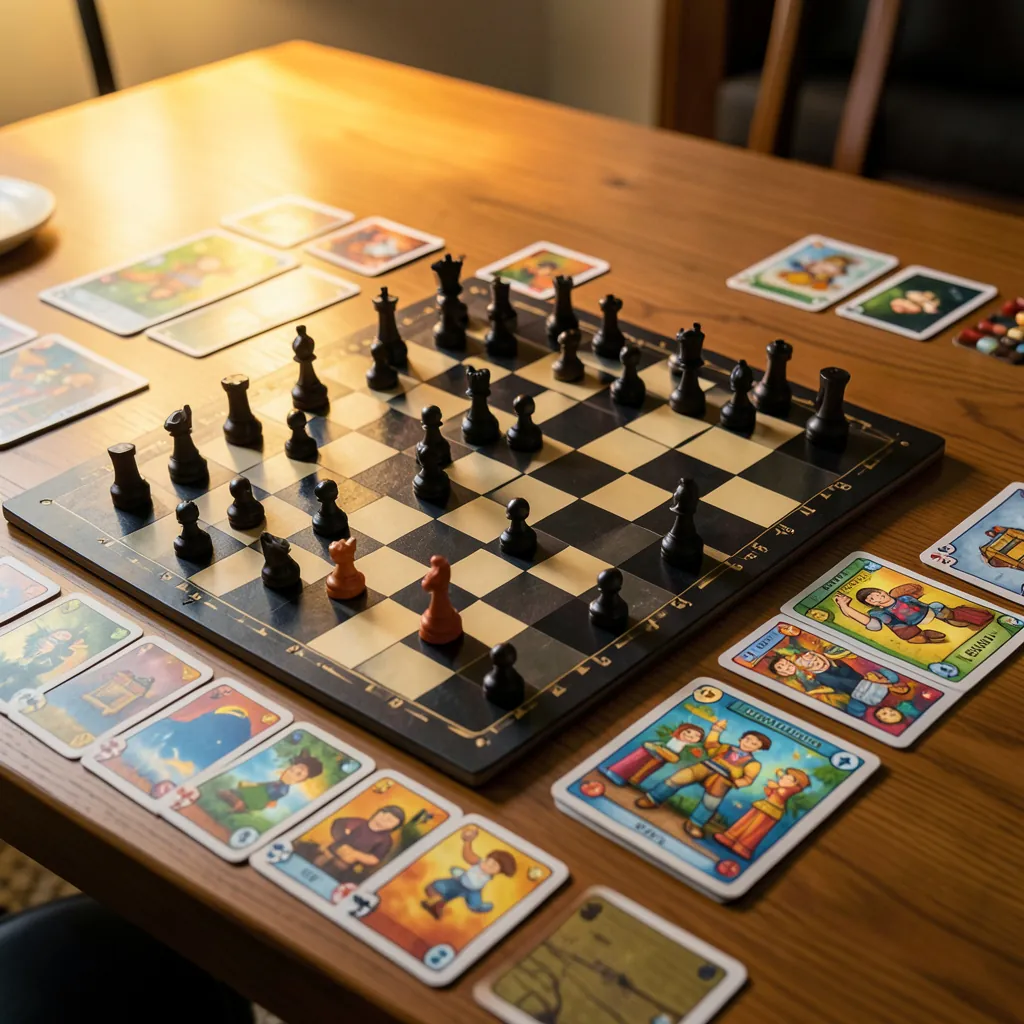
How to Set Up and Play Checkers on a Standard or Hexagonal Board
Contents
♟️ Checkers is an abstract strategy board game in which two players try to capture or block all opposing pieces. For a standard checkerboard, place the board with a light square at each player’s right-hand corner, give each player 12 pieces, and fill the three dark rows nearest each side. The cited sources describe standard two-player checkers plus a 1929 hexagonal board that allows two, three, four, or six players.
Players: 2 in standard checkers; 2, 3, 4, or 6 on Beaman’s hexagonal checker board (Source 1)
Play Time: Not specified in the cited sources; game length varies
Age: Not specified in the cited sources; Source 3 is titled “Beginner’s Checkers”
Difficulty: Easy (beginner rules)
Type: Abstract strategy board game, not a trick-taking card game in these sources
Setup
Standard checkerboard setup
- Place the board between the two players so that the first square on each player’s right-hand corner is a light one (Sources 3 and 5).
- One player takes 12 red men; the other takes 12 black men (Sources 3 and 5).
- Each player places all 12 men on the dark squares in the three rows nearest them, matching the source diagrams (Sources 3 and 5).
- Use only the dark squares. In standard checkers, moves and captures happen along diagonal rows of dark squares.
Beaman hexagonal board setup
- Source 1 describes a hexagonal game board with hexagonal playing spaces, triangular spaces between them, neutral zones around a central “great star” playing area, and colored corner stars used to match players to sets.
- Each player uses 12 men of one set, preferably colored or marked to correspond with that player’s corner.
- Player positions in Source 1:
- 2 players: opposite corners, moving alternately.
- 3 players: alternate corners, leaving unoccupied corners between players.
- 4 players: two at adjacent corners and two at the opposite adjacent corners, leaving an unoccupied corner at each side.
- 6 players: singly, as three pairs of partners, or as three against three.
- Partners sit side by side, play goes around the board to the left, and the first play is chosen by lot or another method (Source 1).
- Source 1’s Figure 2 shows one primary checker setup in which seven of a player’s 12 men begin in the neutral space at that player’s corner; the patent text does not spell out the remaining five positions. It notes that other symmetrical setups are possible.
Comparison table: standard vs. hexagonal vs. non-game “checkerboard”
| Aspect | Standard checkers (Sources 3 and 5) | Beaman hexagonal checkers (Source 1) | Non-game “checkerboard” uses (Sources 2 and 4) |
|---|---|---|---|
| Board | 8x8 checkerboard; light square at each player’s right corner | Hexagonal board with hexagonal spaces, triangular gaps, neutral zones, and a central “great star” | Calibration pattern or digital grid, not a physical game board |
| Players | 2 | 2, 3, 4, or 6; partnerships possible | Not applicable |
| Pieces per player | 12 red vs. 12 black | 12 men per set/player | Not applicable |
| Starting placement | 12 men on dark squares in the three rows nearest each player | Figure 2 shows seven men in the neutral corner space; other symmetrical setups possible | Source 2 defaults to a 15 cm x 18 cm pattern; Source 4 uses array values such as empty=0, white=1, red=2 |
| Movement | Diagonal forward on dark squares; kings move and jump both directions | Along files: direct and diagonal moves, capture jumps, partner-leap moves; kings move backward | Not applicable |
| Win condition | Capture all opponent’s men or block all moves | General checkers objective, modified by the patent’s hexagonal rules | Not applicable |
Conflict/variant note: Sources 3 and 5 agree on standard two-player checkers. Source 1 is not a contradiction; it is a different hexagonal board and rule set. Sources 2 and 4 use “checkerboard” for a calibration pattern and a programming grid, not for physical checker play.
How to Play
- Choose colors and orient the board. Place the standard board so each player has a light square in their right-hand corner. One player uses 12 red men; the other uses 12 black men (Sources 3 and 5).
- Black moves first. Black begins by moving one front-line man one square forward along either diagonal row of dark squares (Sources 3 and 5).
- Move one man per turn. On each turn, move one man one square diagonally forward to an unoccupied dark square. Players alternate turns.
- Capture by jumping. If an opponent’s man is in the next diagonal square forward and the dark square directly behind it in the same diagonal line is empty, you must jump that man and land in the empty square. Remove the captured man from the board (Sources 3 and 5).
- Complete multiple jumps. If several successive jumps are available in a straight or zigzag forward direction, you must make all of them (Sources 3 and 5).
- Do not ignore a required capture. A player must capture whenever possible. If they do not, the opponent may “huff” them—that is, remove the man who should have made the capture as a penalty (Sources 3 and 5).
- King your men. If one of your men reaches your opponent’s backline, it becomes a King. The opponent places a captured man on top of it to mark this. A King can move in any direction along empty adjoining dark squares and can jump in any diagonal direction, forward or backward (Sources 3 and 5).
- Win the game. The first player to remove all opponent’s men—or block the opponent so they cannot move—wins (Sources 3 and 5).
Hexagonal variant rules from Source 1
- Moves are made along “files.” A simple move is from one spot to an adjacent unoccupied spot in the same file.
- A capturing move is a jump over an opponent’s adjacent piece in the same file to an unoccupied spot just beyond it; the captured piece is removed.
- A “leaping” move is a jump over a partner’s piece exactly like a capture, but the partner’s piece stays on the board.
- A regular man can move forward only; after becoming a King, it can move backward too.
- The center star is a King spot for all players: a man occupying it becomes a King. A man may also become a King by occupying a spot at either point of the great star adjacent to the corner opposite his starting corner.
Scoring
The cited beginner checkers rules do not use a point score. Winning is determined by capture and blocking: the first player to remove all opponent’s men, or to block the opponent so they cannot move, wins (Sources 3 and 5). The “huffing” penalty removes a man who failed to capture when required, but it is a penalty rather than a point-scoring system.
💡 Strategy Tips
- Check for mandatory captures first. Beginners often move a different piece and allow the opponent to “huff” the man that should have captured.
- Finish every multi-jump. If a jump chain is available, you must take all possible successive jumps in the forward direction.
- Protect your back row. Preventing opposing men from reaching your backline limits how many Kings your opponent can create.
- Use Kings carefully. Kings are powerful because they can move and jump both forward and backward, but they can still be trapped.
- Avoid leaving single pieces exposed. Look for positions where your opponent can force a jump chain, especially near the edges.
🎲 Variations
- Standard two-player checkers: The main rules in Sources 3 and 5 are for two players only. No separate two-player variant is needed for standard checkers.
- Beaman hexagonal checkers: Source 1 allows two, three, four, or six players. With four, players can play singly or as two-person partnerships. With six, players can play singly, as three pairs of partners, or as three against three.
- Partnership play on the hexagonal board: Partners sit side by side, and play goes around the board to the left. The first play is chosen by lot or another method.
- Huffing penalty: In standard checkers, if a player fails to capture when required, the opponent may remove the man who should have made the capture. The source says the opponent “may” enforce this penalty, so it is not automatic unless players agree to enforce it.
❓ FAQ
What is the correct checkerboard setup?
Place the board so each player has a light square in their right-hand corner. Give each player 12 men—one side red and one side black—and place all 12 men on the dark squares in the three rows nearest each player (Sources 3 and 5).
How many players can play checkers?
Standard checkers is a two-player game. The 1929 Beaman hexagonal checker board in Source 1 allows two, three, four, or six players, including partnership play.
How do you win at checkers?
You win by capturing all of your opponent’s men or by blocking them so they have no legal move. The cited beginner rules do not use a points score (Sources 3 and 5).
Can you play checkers with 2 players?
Yes. Standard checkers is designed for two players. On the hexagonal variant, two players sit at opposite corners and move alternately (Sources 1, 3, and 5).
Is checkers hard to learn, and how long does a game take?
Checkers is easy to learn from beginner rules: move diagonally, jump to capture, make Kings on the backline, and win by capture or block. The cited sources do not specify a play time; game length varies.
What do you need to play checkers?
For standard checkers, you need an 8x8 checkerboard and 12 red plus 12 black men for two players. For the hexagonal variant, you need the Beaman-style hexagonal board and 12 men per player or set. A “checkerboard” calibration pattern or digital array is not a physical game setup.
Related guides
- Backgammon Direction of Play: Complete How-to-Play Guide
- How to Play Backgammon: Complete Rules, Setup & Strategy Guide
- backgammon how to
- How to Play Backgammon: Complete Rules, Setup, Scoring, and Strategy