How to Play Battleship: Rules, Setup, Scoring and Variations
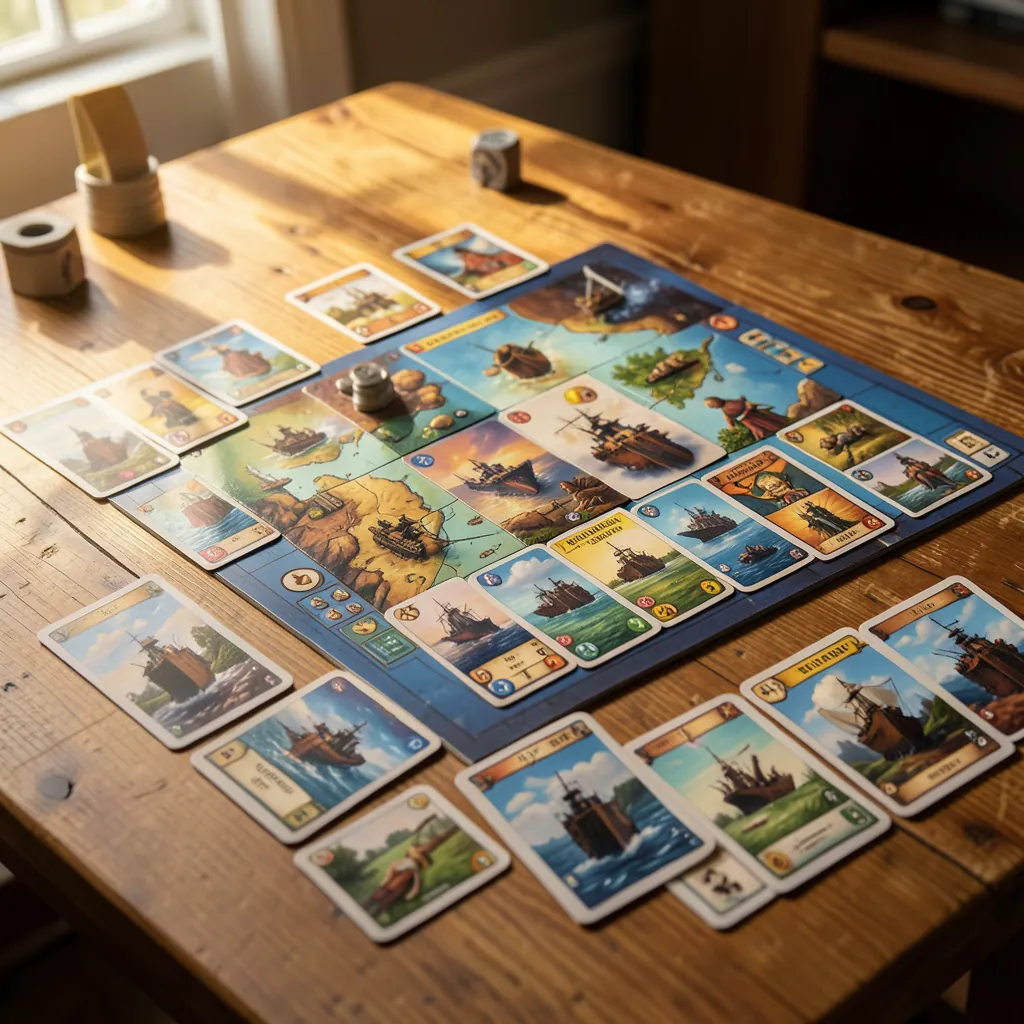
How to Play Battleship: Rules, Setup, Scoring and Variations
Contents
🎲 Battleship is a two-player hidden-information board game in which each player secretly deploys a fleet of ships on a grid, then takes turns calling out coordinates to hunt down the opponent’s fleet. The goal: sink every one of your opponent’s ships before they sink yours. These rules are drawn from Hasbro’s official Battleship product instructions and a published description of the classic rules — where sources disagree, the difference is flagged.
Players: 2 Play Time: Not stated in the sources; a single game runs until one fleet is sunk (typically well under 30 minutes) Age: 7+ (Hasbro classic and Road Trip editions) Difficulty: Easy Type: Two-player strategy board game (hidden information / deduction)
Setup
- Give each player a board with two grids. Each player needs an “ocean” grid where their own fleet sits, plus a separate tracking grid to record torpedoes fired at the opponent (Source 1: “each player also creates another board with the same size in order to record the torpedoes shot into the opponent’s fleet, as well as their status (hit or miss)”). Hasbro’s consumer edition builds this in: the vertical target grid keeps you from seeing each other’s deployment.
- Position the grids so your fleet stays hidden. The target grid must be vertical or screened, because the placement phase is meant to be secret.
- Secretly place your ships on your ocean grid. Ships may be placed horizontally or vertically only, and each ship occupies consecutive cells; every cell is either part of a ship or an empty cell (Source 1).
- Place the correct number and types of ships — this is where the sources conflict. Source 1 describes the classic fleet as 5 battleships of different sizes, occupying 1×1, 1×2, 1×3, 1×4 and 1×5 cells on a 10×10 board. Hasbro’s classic product copy tells players to “deploy your 4 ships” and the box contains 8 plastic ships (two fleets). ⚠️ Conflict flagged: the source set does not agree on fleet size (5 vs. 4 per player) — follow the fleet chart printed in the box you own rather than assuming one number.
- Sort your pegs. Red pegs mark hits and white pegs mark misses (Hasbro); Source 1 recommends simply recording hits and misses on your second board.
Which Battleship version are you setting up?
| Feature | Classic Hasbro Battleship (Sources 2 & 5) | Road Trip Series (Source 3) | Classic rules as described in Source 1 |
|---|---|---|---|
| Players | 2 | 2 | 2 |
| Ships in the box | 8 plastic ships; product copy says deploy 4 per player | 10 plastic ships | 5 per player, occupying 1–5 consecutive cells |
| Board | Ocean base with a vertical target grid | Portable case with ocean grid; game can be paused and resumed | 10×10 grid plus a second recording board |
| Markers | 60 red pegs (hits), 140 white pegs (misses) | 84 red, 168 white, 4 black pegs | Hits/misses recorded on the second board |
| Special rule | — | Black “Stop Sign” peg: your shot backfires and the opponent calls 5 shots at once | — |
| Age rating | 7+ | 7+ | Not stated |
How to Play
- Choose who fires first. Play proceeds in rounds, and the players switch roles each round — one player shoots, then the other (Source 1).
- Announce one target cell on the opponent’s board. Name the exact cell being targeted (e.g. a letter-and-number coordinate such as the rows A–J and columns 1–10 shown in Source 1’s board diagram).
- Both players record the shot. Per Source 1, once the cell is announced, both players record the shot so the game can be verified later.
- The opponent answers “hit” or “miss.” The defending player announces whether the targeted cell contains part of one of their ships (Source 1). With a physical Hasbro set, peg the result — red for a hit, white for a miss — so you don’t waste shots by re-firing at a known miss.
- Announce a sinking. If all parts of a ship have been hit, the ship’s owner must announce “This ship was sunk” (Source 1).
- Continue alternating shots until one player’s entire fleet is sunk — every round consists of one torpedo launched at one cell of the opponent’s board.
- End the game and verify. When one fleet is fully sunk, the opponent wins. Pedantic players may compare their own shot records against the opponent’s board layout afterwards to check they weren’t cheated — Source 1 notes this is not a full guarantee, since a dishonest opponent could in principle have moved ships mid-game.
Scoring
Battleship is an elimination game, not a points game: neither Hasbro’s instructions nor Source 1’s classic rules award points per hit. You win by sinking every ship in the opponent’s fleet — “in the eventual outcome that a fleet of one of the players is sunk (i.e. all the battleships are sunk), the game ends and the opponent will be announced as the winner” (Source 1). The only record-keeping is the hit/miss log on your target grid, which doubles as your evidence if you want to verify the result at the end.
⚠️ Conflict flagged: the University of Oklahoma “Battleship Rules” document (Source 4) is a different game that shares the name — a canoe water battle, not the board game. Its scoring is therefore not comparable: each match is 10 minutes, 4 boats in the pool, and a team earns 1 point for each boat still afloat with all players aboard when another boat sinks; the most points after 10 minutes wins. Do not mix those rules into tabletop play.
💡 Strategy Tips
- Keep a clean hit/miss log. Use white pegs (or your tracking board) for misses so you never waste a shot on a cell you’ve already called — Hasbro’s instructions describe this as the whole point of tracking misses.
- Use logic, and take some chances. Hasbro’s own product copy frames the game as deduction plus calculated risk: pure pattern-hunting is slow, and pure guessing is wasteful.
- Think about ship geometry when you’re placing. Ships must be horizontal or vertical and occupy consecutive cells, so once an opponent hits you they will start probing along that line — “position ships strategically to survive relentless strikes” (Source 3).
- Finish what you start. Because a ship only counts when all its cells are hit, spreading fire across the whole board leaves damaged ships alive; concentrate fire to convert hits into sinkings.
- Beginner mistake to avoid: forgetting that shot records are mutual. In the classic rules both players record every shot, which is also how disputes get settled at the end.
🎲 Variations
- Road Trip “Stop Sign” rule (Source 3). In the Hasbro Road Trip Series edition, a shot that calls out a coordinate containing your opponent’s black “Stop Sign” peg backfires: the opponent then gets to call out 5 shots at once.
- Advanced salvo game (Source 3). The Road Trip edition “includes suggestions for an advanced salvo game,” letting you fire multiple shots per turn — the sheet’s specific salvo rules aren’t reproduced in the source text, so check the printed rules in the box.
- Pause and resume (Source 3). The Road Trip case can be closed mid-game and reopened later to pick up exactly where you left off — useful for interrupted games.
- Player-count variants — ⚠️ conflict flagged. Hasbro lists Battleship as “For 2 players” and Source 1 calls it “a well known traditional board game for two players,” so 2 players is the only supported count for the board game. Source 4’s “Battleship Rules,” however, requires at least 4 and up to 5 players per team (3 in the canoe, 1–2 navigators), with 4 boats in the pool — that is a separate pool/canoe activity, not a variant of the tabletop game.
- Two-player confirmation: you don’t need a variant to play with 2 — 2 players is the standard game.
❓ FAQ
How many players can play Battleship? Two. Hasbro’s classic and Road Trip editions both state “For 2 players,” and the classic rules description calls it a two-player game. (The 4–5 player “Battleship” in Source 4 is a canoe water game, not the board game.)
How do you win at Battleship? Sink all of your opponent’s ships. Play continues in alternating shots until one player’s fleet is completely sunk; that player loses and the opponent wins. There are no points to add up in the standard board game.
Can you play Battleship with more than 2 players? Not according to the official Hasbro rules, which specify 2 players only. The only multi-player version in the sources is Source 4’s team canoe event (4–5 people per team), which uses buckets, canoes and a pool rather than grids and pegs.
Is Battleship hard to learn? No — it’s rated ages 7 and up and the core loop is simple: call a coordinate, get told hit or miss, mark it, repeat. The only thing to learn before your first game is your fleet’s ship sizes and how to place them (horizontal/vertical, consecutive cells only).
How long does a game of Battleship take? Neither Hasbro nor the classic rules description states a fixed playing time; a game simply runs until one fleet is sunk. (The 10-minute match length in Source 4 applies only to the canoe version.)
What do you need to play Battleship? A board with an ocean grid and a hidden vertical target grid for each player, a fleet of plastic ships, and red pegs for hits plus white pegs for misses (the classic Hasbro set includes 8 ships, 60 red pegs and 140 white pegs; the Road Trip case includes 10 ships, 84 red pegs, 168 white pegs and 4 black pegs). With paper, you can substitute two 10×10 grids and a pencil.
Related guides
- Backgammon Direction of Play: Complete How-to-Play Guide
- How to Play Backgammon: Complete Rules, Setup & Strategy Guide
- backgammon how to
- How to Play Backgammon: Complete Rules, Setup, Scoring, and Strategy