How to Play Battleship: Rules, Setup, Scoring, and Variations
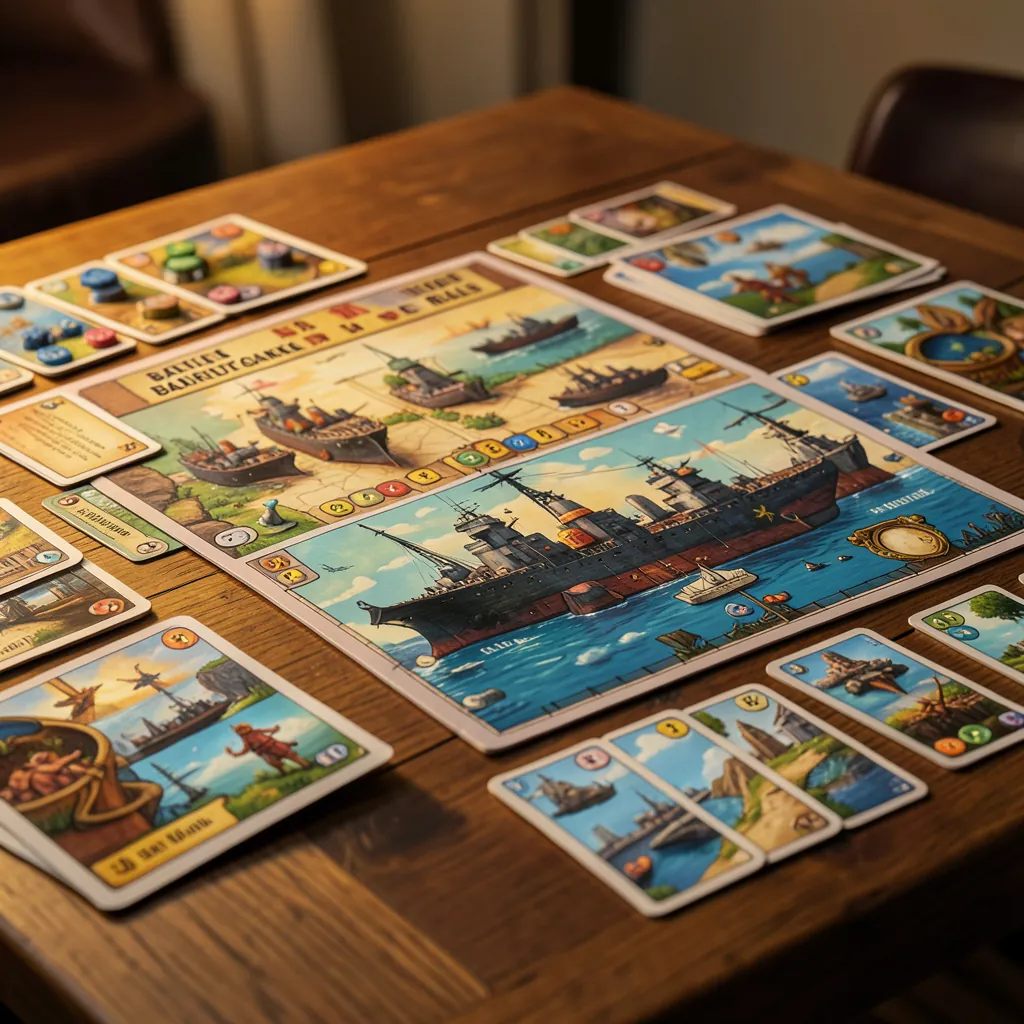
How to Play Battleship: Rules, Setup, Scoring, and Variations
Contents
🎲 Battleship (also called Sea Battle) is a two-player board game in which each player secretly places a fleet of ships on a 10×10 grid and then takes turns calling coordinates to find and sink the opponent’s fleet. The first player to sink all five enemy ships wins. It is a guessing-and-deduction game, not a trick-taking card game.
Players: 2 (Battleship is a two-player game in Sources 2, 3, and 5; the “3–5” sample in the brief does not match Battleship)
Play Time: Not specified in the supplied sources; play continues until one fleet is sunk
Age: 7+ (Hasbro Classic, Source 3)
Difficulty: Easy/simple deduction (Hasbro lists ages 7+; sources describe a guessing/deduction game)
Type: 2-player board game / naval-combat guessing game
Setup
- Separate the two playing consoles and sit facing each other. Open the lids so each lid forms a barrier that hides your ocean grid from your opponent; keep the lids open during play (Source 5).
- Each player takes one fleet of five ships and removes the ships from their runners if needed (Source 5).
- Secretly place your fleet on your ocean grid. Ships may be placed horizontally or vertically, and no part of a ship may be off the grid (Source 5). Source 1 also describes ships as occupying consecutive cells.
- Take your hit and miss pegs and place them in the storage areas beside your ocean grid (Source 5). Depending on the edition, miss pegs may be white (Source 5) or green (Source 3); hit pegs are red.
- Keep your ocean grid hidden. Use your target grid to record shots at the opponent’s fleet (Source 5).
What ships are in the standard fleet?
Sources do not agree on every ship name and length, so check your edition. The table below flags the differences instead of silently choosing one version.
| Source / edition | Ships and lengths | Notes |
|---|---|---|
| Source 5, Hasbro-style rules | Aircraft Carrier: 5; Battleship: 4; Cruiser: 3; Submarine: 3; Destroyer: 2 | Red pegs mark hits; white pegs mark misses in this edition. First to sink all five wins. |
| Source 2, Baidu entry | Aircraft Carrier: 5; Battleship: 4; Cruiser or Destroyer: 3; Submarine: 3 or 2; Patrol Boat: 2 | Uses a 10×10 grid; names and one length vary by edition. |
| Source 3, Hasbro product listing | Aircraft carrier, destroyer, submarine, patrol boat, battleship; lengths not listed | Confirms 2 players and ages 7+; this listing uses green miss pegs. |
| Source 1, paper/blockchain paper | Five ships of different sizes, occupying consecutive cells | Its caption lists sizes from 1×1 through 5×5, which does not match the common Hasbro fleet names and lengths. |
How to Play
- On your turn, call one coordinate made from a letter and a number, such as “B5” (Source 2) or “H0” (Source 5). Use the labels printed on your edition’s board.
- The defender checks their secret ocean grid and truthfully announces “Hit!” if the called cell contains part of a ship, or “Miss!” if it is empty (Sources 2, 4, and 5).
- The defender marks a hit on their own ship with a red peg on the ocean grid (Source 5).
- The attacker records the shot on their target grid: use a red peg for a hit and a white or green peg for a miss, depending on the edition (Sources 3 and 5).
- If every cell of a ship has been hit, that ship is sunk. Remove it from the ocean grid and tell the opponent what kind of ship was sunk (Source 5); Source 1 also says the owner announces when a ship is sunk.
- In classic play, turns alternate after one shot. Source 1 describes one torpedo shot per round, and Source 5 says players take turns calling coordinates. Do not take an extra shot just because you hit unless you are using a Salvo variant.
- Continue until one player’s entire fleet is sunk. That player loses; the opponent wins (Sources 1 and 5).
Scoring
Classic Battleship is not scored by a point total in the supplied rules; it is a win/loss game. A ship is sunk when all its cells or holes have been hit, and the first player to sink all five enemy ships wins (Source 5). Source 1 gives the same end condition: when all ships in one fleet are sunk, the game ends and the opponent is the winner. Digital or special editions may add ranks, points, or modes, but those are edition-specific rather than part of the classic tabletop rules (Source 2).
💡 Strategy Tips
- Track every shot on your target grid. Red means hit; white or green means miss depending on your edition (Sources 3 and 5). This prevents repeated calls and supports deduction.
- When you get a hit, test adjacent cells to learn the ship’s orientation and length, because ships occupy consecutive horizontal or vertical cells (Source 1).
- Use a systematic search pattern instead of random shots; Battleship is a guessing-and-deduction game (Source 2), so covering empty areas methodically helps you find ships faster.
- Place ships strategically and keep your ocean grid hidden behind the console lid (Sources 3 and 5). A predictable layout is easier for an opponent to deduce.
- Common beginner mistakes: forgetting to announce hit or miss truthfully, failing to mark hits and misses, and forgetting to remove and announce a sunk ship. The rules require truthful reporting and clear marking (Sources 2 and 5).
🎲 Variations
- Standard 2-player game: This is the only player count supported by the main sources. Sources 2, 3, and 5 describe Battleship as a two-player game; no 3–5 player standard rule is given.
- Salvo: Hasbro’s product listing says the game includes a Salvo feature that lets advanced players launch multiple attacks (Source 3). Source 2 describes Salvo as firing a number of shots equal to the number of ships you have remaining each turn. The exact Salvo formula varies by edition, so use your edition’s rules.
- 12×12 edition variant: Source 2 describes a specific digital/edition variant using a 12×12 board, a different fleet, special placement restrictions, and three shots per turn. That is not the classic Hasbro 10×10 ruleset.
- Digital versions: Source 2 mentions video-game adaptations such as Sea Battle 2, Ubisoft’s 2016 PlayStation 4 game, and a Hasbro-licensed 2018 Steam game with extra modes. These add digital features, but they do not replace the classic tabletop rules.
❓ FAQ
How many players can play Battleship?
Two players. Sources 2, 3, and 5 all describe standard Battleship as a two-player game.
How do you win Battleship?
Sink all five of your opponent’s ships first. The first player to sink the entire enemy fleet wins (Source 5).
Can you play Battleship with 2 players?
Yes. Two players is the standard and intended player count (Sources 2, 3, and 5).
Is Battleship hard to learn?
No. It is a simple guessing-and-deduction game, and Hasbro lists the Classic edition for ages 7 and up (Source 3).
How long does a game take?
The supplied sources do not give a fixed play time. A classic game continues until one player’s fleet is completely sunk.
What do you need to play?
You need two grids or playing consoles, two fleets of five ships, and red hit pegs plus white or green miss pegs depending on the edition (Sources 3 and 5). Source 2 also notes that the game can be played as a pencil-and-paper game with 10×10 grids.
Related guides
- Backgammon Direction of Play: Complete How-to-Play Guide
- How to Play Backgammon: Complete Rules, Setup & Strategy Guide
- backgammon how to
- How to Play Backgammon: Complete Rules, Setup, Scoring, and Strategy
- How to Play Basic Checkers (Draughts): Rules, Setup, Strategy and Variations