How to Play Battleship: Setup, Rules, Scoring, and Variations
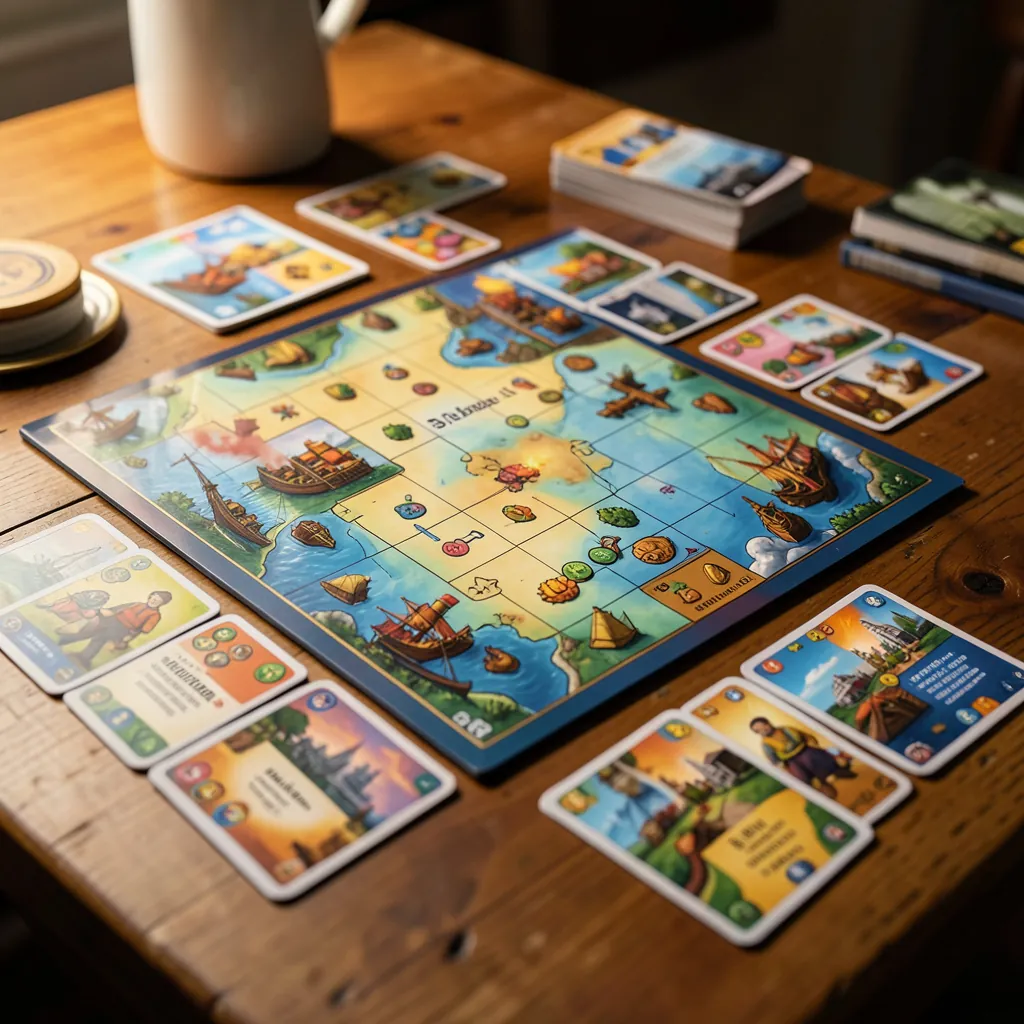
How to Play Battleship: Setup, Rules, Scoring, and Variations
Contents
🎲 Battleship is a two-player hidden-fleet board or paper game: each player secretly places ships on a coordinate grid, then players call shots to locate and sink the opponent’s fleet. The first player to sink all of the opposing ships wins. The core rules are simple, but fleet sizes, turn order, and coordinate origins vary by edition, as flagged below.
Players: 2 (or two teams; Source 6)
Play Time: Not stated as a fixed time in the sources; varies by edition and luck
Age: 7+ (Source 6; other sources do not state an age)
Difficulty: Easy (the core rules are simple call-and-record; computer versions add interface steps)
Type: Two-player hidden-fleet board/paper game
Setup
- Give each player one game board/grid and one set of ships. In the printable version, print one board and one set of five ships per player; cut out the ships or draw them directly on the grid (Source 6).
- Each player secretly places their fleet on their own ocean grid. Use a book, folder, or screen between players so the fleets stay hidden (Source 6).
- Place ships only horizontally or vertically. Ships cannot overlap or extend beyond the grid (Source 6; Source 2). Source 4’s console version also prohibits adjacent ships; check your edition’s rule before play.
- Decide the coordinate system and first player before the first shot. Coordinate origins and first-turn rules conflict across sources—see the conflict notes below.
Which ships and ship lengths should you use?
| Version / source | Ships per player | Ship lengths or damage to sink | Key setup notes |
|---|---|---|---|
| Printable two-player version (Source 6) | 5: aircraft carrier, battleship, submarine, cruiser, destroyer | 5, 4, 4, 3, 2 spaces | Horizontal/vertical; no overlap or off-grid; age 7+. |
| Computer manual version (Source 2) | 5: aircraft carrier, battleship, destroyer, submarine, patrol boat | 5, 4, 3, 3, 2 spaces | X/Y coordinates; (1,1) top left; (10,10) bottom right. |
| Online JavaScript version (Source 3) | 3: battleship, cruiser, destroyer | Battleship sinks at 5+ damage units; cruiser at 3+; destroyer at 2+ | Bomb radius/power slider; you and the computer each have 3 ships. |
| Java console version (Source 4) | 8 ships, 25 total spaces | A ship sinks when hit once for each space it occupies | 10×10 grid; no overlap or adjacency; coordinates A1–J10. |
| OSU manual version (Source 5) | 5 ships (types/lengths not fully listed in the excerpt) | Not specified in the excerpt | Orientation input: 1 = vertical, 2 = horizontal; rows/columns 1–10. |
Conflict flag: Fleet composition is not consistent across sources. Source 6’s five-ship fleet has a 4-space submarine and a 3-space cruiser; Source 2’s five-ship fleet has a 3-space submarine, a 3-space destroyer, and a 2-space patrol boat; Source 3 uses only three ships; Source 4 uses eight ships. Use the roster that came with your edition.
How to Play
- Agree who fires first. Sources conflict: Source 3 says the human goes first; Source 2 has the human fire before the computer; Source 5 says the computer gets the first shot. For tabletop play, choose a first player before starting.
- Call one coordinate on the opponent’s grid. For example, the printable game uses calls such as “B4” (Source 6), while the console version uses A1–J10 (Source 4). Use the labels printed on your board.
- The opponent checks the secret fleet grid and announces “hit” or “miss.” A hit means a ship occupies that space; a miss means the space is empty (Source 6). Computer versions often use red for a hit and white for a miss (Source 2; Source 5).
- Record the result on your target grid so you remember which coordinates have already been called (Source 6). In computer versions, the marker appears automatically (Source 2; Source 5).
- Pass the turn after the shot and continue alternating one shot at a time (Source 6). Do not give an extra turn for a hit unless your specific edition says to.
- Announce a sunk ship when every space it occupies has been hit (Source 6). Source 4 states the same rule: a ship is sunk when it is hit once for each space it occupies.
- End the game when one player has sunk all of the opponent’s ships. That player wins (Source 6; Source 2; Source 3; Source 4; Source 5).
How do the coordinate systems differ?
Conflict flag: Source 1 describes a classroom grid with a bottom-left origin and letter/number axes; it notes that C4 can also be described as 5 spaces from the origin at 49° above horizontal. Source 2 instead makes (1,1) the top-left corner and (10,10) the bottom-right. Source 5 starts rows at 1 from the top. Do not assume a universal origin—use the coordinate labels on the board or program you are playing.
How do online or computer versions differ?
- Source 3 online version: Click the ocean to drop a bomb; a slider sets bomb power/damage and radius. Higher damage means a smaller radius. Start with a large radius/low damage to search, then increase power when you locate a ship. You go first, and the first player to sink all opposing ships wins.
- Source 2 computer manual: The opponent’s grid is on top and yours is on the bottom. Enter X and Y coordinates; hits fill with a red marker and misses with a white marker. If you hit, the manual instructs you to fire north, south, east, or west of that location to determine the ship’s orientation.
- Source 4 console version: The menu offers a classic 10×10 game vs the computer, a computer-vs-computer simulation, rules/legend, or exit.
- Source 5 computer manual: Orientation input is 1 for vertical and 2 for horizontal; after placement, the computer gets the first shot.
Scoring
Standard Battleship does not use a point total. Players track hits and misses, and the winner is the first player to sink all of the opponent’s ships (Source 6). A ship is sunk when every space it occupies has been hit (Source 6; Source 4).
Scoring is edition-specific. Source 4 counts hits: its eight ships occupy 25 total spaces, so the first player to record 25 hits wins—equivalent to sinking the full fleet in that edition. Source 3 uses damage units: the battleship needs 5+ damage to sink, the cruiser 3+, and the destroyer 2+; the first player to sink all opposing ships wins. Sources 2 and 5 use red/white hit-and-miss markers and end when all five ships are sunk.
Conflict flag: Do not apply Source 4’s 25-hit target or Source 3’s damage-unit system to a standard five-ship printable set. Use the scoring/win condition from your specific edition.
💡 Strategy Tips
- Spread your ships out. Avoid grouping the whole fleet in one corner or one cluster (Source 6).
- Mix horizontal and vertical placements. This makes it harder for the opponent to infer the rest of a ship after one hit (Source 6).
- Track every hit and miss. Keep a careful record on your target grid so you do not waste calls on known misses (Source 6).
- After a hit, search nearby coordinates. Try adjacent spaces to find the rest of that ship (Source 6). In Source 2’s computer version, the manual specifically suggests firing north, south, east, or west of a hit to determine orientation.
- Common beginner mistakes: clustering ships, forgetting to record shots, and mixing ship rosters from different editions. In Source 3’s bomb-slider version, start with a large radius/low damage to search, then increase power once a ship is located.
🎲 Variations
- Two-player standard: Battleship is designed for two players; the printable version needs one board and one set of ships per player (Source 6).
- Team play: Source 6 suggests dividing a larger group into two teams and letting team members decide which coordinates to call.
- Computer/online play: Source 3 is an online game vs the computer. Source 4’s console menu includes classic 10×10 vs the computer and computer-vs-computer simulation. Sources 2 and 5 are computer user manuals.
- Fleet-size variants: Source 3 uses 3 ships; Sources 2, 5, and 6 use 5 ships; Source 4 uses 8 ships. Always use the ship roster from your edition.
- Placement variants: Source 4 prohibits adjacent ships; Source 6 only explicitly says ships cannot overlap or extend beyond the grid. Agree on this before play if you are using a house set.
- Turn-order variants: Source 3 says you go first; Source 5 says the computer goes first. For tabletop play, choose a first player before starting.
- Classroom/physics extension: Source 1 describes using vectors to identify positions, e.g., C4 as 5 spaces from a bottom-left origin at 49° above horizontal. This is an educational exercise, not a standard Battleship rule.
❓ FAQ
How many players can play Battleship?
Two players. Source 6 notes that larger groups can split into two teams and decide coordinates together.
How do you win Battleship?
Sink all of the opponent’s ships. In Source 4’s eight-ship console version, this is expressed as the first player to record 25 hits because the fleet occupies 25 total spaces.
Can you play Battleship with 2 players?
Yes—Battleship is designed for two players. The printable version requires one game board and one set of ships for each player (Source 6).
Is Battleship hard to learn?
No. The core rules are call a coordinate, hear “hit” or “miss,” record the result, and sink all opposing ships (Source 6). Source 6 recommends ages 7 and older; computer versions add interface steps.
How long does a game take?
The provided sources do not give a fixed play time. Length varies by edition, fleet size, and how quickly players find each other’s ships.
What do you need to play Battleship?
For tabletop/printable play, you need two grids or boards, two sets of ships or a pen/pencil, and a barrier/folder to hide fleets (Source 6). For computer versions, you need the specific program or website; Source 4, for example, requires Java 8+.
Related guides
- Backgammon Direction of Play: Complete How-to-Play Guide
- How to Play Backgammon: Complete Rules, Setup & Strategy Guide
- backgammon how to
- How to Play Backgammon: Complete Rules, Setup, Scoring, and Strategy
- How to Play Basic Checkers (Draughts): Rules, Setup, Strategy and Variations