How to Play Checkers: Basic Rules, Setup, Scoring, and Variations
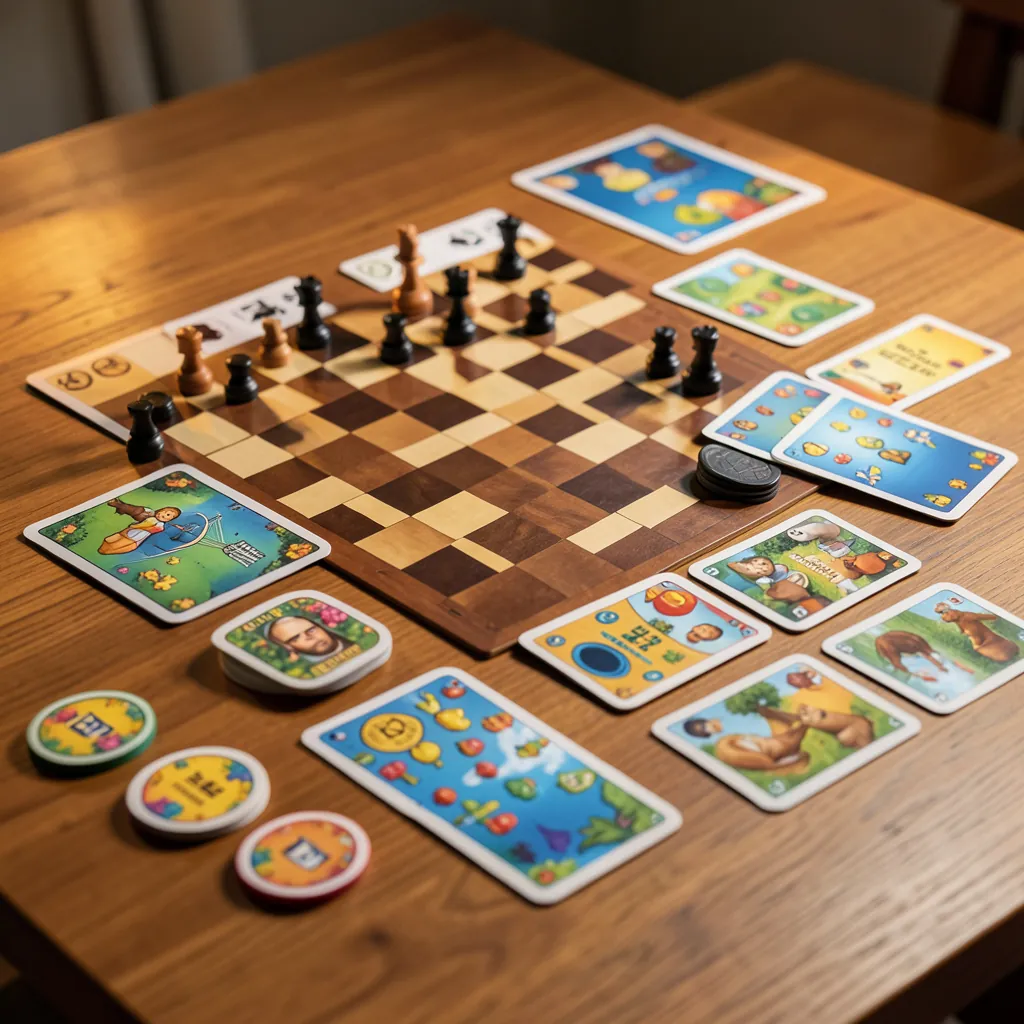
How to Play Checkers: Basic Rules, Setup, Scoring, and Variations
Contents
♟️ Checkers—called draughts in Britain—is a two-player abstract strategy board game played on an 8×8 board with 12 pieces per side. The goal is to capture all opposing pieces or block them so they have no legal move. Basic English/American checkers is easy to learn: pieces move diagonally forward, captures are compulsory, and a piece reaching the far row becomes a king.
Players: 2
Play Time: Not fixed; varies by game (cited sources give no standard time)
Age: 5+ for simple rules and many family sets (Source 5)
Difficulty: Easy to learn; deeper strategy (Sources 2 and 5)
Type: Abstract strategy board game (English/American checkers or draughts)
Setup
- Use a standard 8×8 chess-style board with 64 alternating light and dark squares. Only the 32 dark squares are used in play.
- Place the board so each player has a dark square at the near-left corner.
- Each player takes 12 disk-shaped pieces in contrasting colors, traditionally called Black and White or Red and White.
- Place all 12 pieces on the dark squares of the three rows nearest each player. That fills 12 dark squares per side and leaves the two middle rows empty.
- In numbered notation, Black pieces start on squares 1–12 and White pieces on squares 21–32.
- Black moves first. For informal play, use the standard starting position rather than tournament opening restrictions.
How to Play
-
Black moves first. Players alternate turns, moving one piece per turn. There is no dice-rolling or chance element in standard checkers.
-
Move ordinary pieces diagonally forward. A regular piece, often called a “man,” moves one square diagonally forward onto an empty dark square. Ordinary pieces cannot move sideways, straight ahead, or backward.
-
Capture by jumping. If an opponent’s piece is diagonally adjacent and the square immediately beyond it is empty, jump over it and remove it from the board. In standard modern English/American checkers, captures are compulsory: if a capture is available, you must take it. If several captures are available, you may choose which one to take, but you must take one. If the same piece can jump again after landing, it must continue jumping.
-
Crown kings. When a piece reaches the opponent’s back row—the king row—it is promoted to a king. Traditionally, this is shown by stacking a second same-color piece on top. A king may move and capture one square diagonally forward or backward.
-
End the game by capture or blockade. A player wins by capturing all opposing pieces or by blocking the opponent so they have no legal move. If neither side can force a win and play becomes repetitious, the game is a draw.
What rules do sources disagree on?
- Compulsory capture vs. the old “huff” law: Sources 2, 3, and 5 describe compulsory capture in modern English/American checkers. Wendemuth’s 1922 standard laws instead describe a “Huff” or “Blow,” where a player may remove an opponent’s piece that failed to take, compel the take, or let the piece remain. That older law conflicts with the modern compulsory-capture rule; agree on house rules before play.
- Promotion during a jump: Britannica says that if a piece moves into the last row with a capture, it must continue capturing backward if possible. Jaques says a piece that reaches the king row ends its move there even if it arrived by a jump and cannot continue capturing that same turn. The sources conflict, so this is a rule-set or house-rule decision.
Scoring
Standard checkers is not scored with numerical points. A player wins when all opponent pieces are captured or the opponent is blocked and has no legal move. A loss is the reverse. A draw is declared when neither side can force a win and play becomes repetitious.
In match play, wins and draws can count, and an older tournament rule requires an even number of games so each player has the first move the same number of times. Wendemuth’s 1922 laws also state that when one side appears stronger, that side must complete the win or show a decided advantage within 40 of its own moves, or the game is relinquished as a draw.
💡 Strategy Tips
- Control the center. Pieces in the middle command more diagonals and more squares than pieces stuck on the edge. Edge pieces are safer but passive.
- Protect your back row. The pieces guarding your king row help stop the opponent from crowning a king. Give up the back row only for a clearly larger gain.
- Use compulsory capture against your opponent. Because a capture must be taken, you can offer a piece to force a reply that opens a bigger jump or a two-for-one trade.
- Trade when ahead, avoid trades when behind. Simplifying the position helps the player with more pieces; avoid trading when you are already behind.
- Do not mistake simple rules for simple strategy. Source 2 notes that checkers has deep endgame play and that positions such as “First Position” require precise timing. Source 3 notes that Jonathan Schaeffer’s Chinook program confirmed a perfect-play draw in 2007 after exploring about 39 trillion positions.
🎲 Variations
Standard checkers is a two-player game; the cited sources do not give an official 3–5 player version. For house rules, agree on the two source conflicts noted above—huff versus compulsory capture, and whether crowning ends a capture—before starting.
How do common checkers variants compare?
| Variant | Board | Typical region or note | Key differences from basic 8×8 checkers |
|---|---|---|---|
| English/American checkers (draughts) | 8×8; 64 squares, 32 dark squares used | North America uses “checkers”; British Commonwealth uses “draughts” | 12 pieces each; men move one square diagonally forward; captures compulsory; kings move one square diagonally forward or backward; if multiple captures exist, choose one |
| International checkers | 10×10 | Netherlands, former Soviet Union, Africa | Kings move any number of empty squares diagonally like bishops; captures can be backward; you must choose the capture that takes the most pieces |
| Canadian checkers | 12×12 | Large-board variant | Source 2 notes its popularity has waned partly because it takes too long to complete a game |
| Tournament opening restrictions | 8×8 | Tournament play | Two-move restriction chooses the first move from 47 playable combinations; three-move/American restriction extends to Black’s second move with about 300 prescribed openings; eleven-man ballot removes one piece from each side by lot |
❓ FAQ
How many players can play checkers?
Two. Standard English/American checkers uses 12 pieces per player, and the cited rules describe a two-person game. If you have more than two people, the sources do not provide an official multiplayer rule set.
How do you win at checkers?
Capture all opponent pieces or block them so they have no legal move. A draw occurs when neither side can force a win and play becomes repetitious.
Do you have to jump in checkers?
Yes in standard modern English/American checkers. If a capture is available, you must take it; if multiple captures exist, choose one; multiple jumps must be completed. Older 1922 laws describe a “huff” exception, so agree on house rules.
Is checkers hard to learn?
No—the basic rules are simple enough for a five-year-old to grasp, and many family sets are labeled Ages 5+. The strategy is deep: Source 2 calls the rules simple and elegant, and Source 3 notes that Jonathan Schaeffer’s Chinook program confirmed a perfect-play draw in 2007.
How long does a game take?
The cited sources do not give a fixed time for standard 8×8 checkers; casual games vary. Source 2 notes that the 12×12 Canadian version has waned partly because it takes too long to complete.
What do you need to play checkers?
An 8×8 chess-style board with 64 alternating squares and 24 disk-shaped pieces—12 of one color and 12 of another. Only the 32 dark squares are used, and Black moves first.
Related guides
- Backgammon Direction of Play: Complete How-to-Play Guide
- How to Play Backgammon: Complete Rules, Setup & Strategy Guide
- backgammon how to
- How to Play Backgammon: Complete Rules, Setup, Scoring, and Strategy
- How to Play Basic Checkers (Draughts): Rules, Setup, Strategy and Variations